Monday, October 13, 2008

Into Africa - Part 1

This weekend, I finally got out of the city and went on my first safari. Not only was the actual safari a great time with lots of animals, but the planning, as well as the ride there were also quite an experience. Earlier in the week, I had dinner with my Pfizer colleague, Fiona. She had just arrived from Ireland and was already for an adventure. As I was leaving her apartment, we were chatting with Alex the Taxi Driver and he said he could arrange a trip to the wildlife park at Lake Nakuru, along with a boat ride on Lake Navaisha with one of his drivers.

On the surface, this sounded like a great idea, but upon further examination, we started to doubt whether he could pull it off. The trip was to be with one of his drivers, and our first concern was that his Nairobi guy would know where to go in the park to see the wild beasts. Then, we worried that we would be trekking in a beat-up Toyota Camry, instead of a 4-wheel drive Jeep with an open roof. And finally, Alex said he could get us a room, but what kind? “Hotels” that I’ve seen along the side of the road aren’t what we would consider a room. They advertise that they have water and cost about $2.50 per night (or maybe hour?)

After much debate, we decided to give Alex a chance and see what happened. We negotiated a price, which eventually had a stipulation that if we met up with two other people at the lodge, we would get $100 US back. Even that sounded skeptical, but we decided to take a flyer.

At the very respectable hour of 10:00 am, we started on the road with Michael, the driver. He had a ramshackle van which looked pretty ordinary, but as it turned out, its roof popped up for better camera shots. We headed northwest out of the city, with the first stop being a high escarpment overlooking the Great Rift Valley. It was a spectacular view, with the obligatory stop at a souvenir stand.


The Great Rift Valley

Along the way, Michael gave a running commentary about the land, the people and the animals. He travels the road often as his family lives in Nakuru and although he must live in Nairobi to earn a living, he tries to go home every few months to see his wife and eight children. We saw many Masai herding their cattle and goats, and he explained that the Masai consider the land on the west side of the road theirs and rarely cross to the other side. This time of year, the ground was quite dry and the tribesmen have to move their herds frequently to keep them fed. The short rainy season should start soon, so there will be more green grass shortly. As we traveled north, we also saw a relatively small Internally Displaced Person (IDP) camp. These tents have been made available to people who have been forced out of their homes primarily due to the tribally motivated political unrest earlier in the year. It’s a sad thing to see, as even the poorest of the poor seem better off. We also saw men (some women, but mostly men), just laying on the side of the road. There would be nothing in any direction - no buildings, no cattle, just a guy dozing on the road side. It was as if they were waiting for Godot, and nothing would ever happen, but they would return the next day.

We finally arrived at the Lake Nakuru Wildlife Park around 1 and ate our picnic lunch before entering the reserve. We experienced our first taste of “safari” on the ride to the lodge and spent a few hours looking at antelope, gazelle, zebras, white rhinos and buffalo. In the distance, we could see the lake, rimmed with pink from the thousands of flamingos who stand at its edge.
Cheeky Baboon
Blase Buffalo
Zebra
Warthogs

We were pleasantly surprised when we got to the hotel as it was gorgeous. Clearly, this was a holdover from colonial times and the Brits sure knew how to pick a good property site. Lake Nakuru Lodge is perched high up on a cliff, overlooking the valley and the lake, with unobstructed views. It has beautifully landscaped grounds, and even a Masai warrior employed to shoo away the baboons and any other wildlife that attempted to enter. The rooms were clean and serviceable and most importantly, a great shower with plenty of hot water.
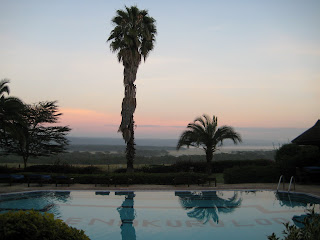
Lake Nakuru Lodge at Dawn

We took a brief rest by the pool and were told to meet Michael at 4 for a late afternoon game drive. When we got to the van, lo and behold, there were the two other people Alex had mentioned and a crisp $100 bill. Chalk up another point for Alex! Tammy and James work for a British consultancy and had been at the lodge all week facilitating a meeting. They decided to stay on a few extra days to enjoy the park before heading back to London. They were fun and easy to travel with, and we spent the rest of the time with them. The afternoon game drive immediately produced two female lions, however they were quite distance. Michael had expert eyes and was able to spot things that I couldn’t see even when we were practically upon them. He insisted it was because I was white and that black people have better vision. I think it’s because it’s time for a revision to my Lasik surgery.
Lioness in the Distance (really)
Ostriches and Rhinos

We then drove down by the lake were we were able to get out of the van and walk to the edge of the water. There were flamingos as far as the eye could see, creating a noisy, fluttery pink rim around the perimeter. There were also groups of white pelicans and the odd cormorant and crane. I’m told that Kenya, and particularly the lake regions, are great places for birders. I don’t pay that much attention to those sharp clawed and spiky beaked creatures, but I did notice that many of the birds had extremely vibrant colors.
Flamingos on the Shore of Lake Nakuru
White Pelicans
More Flamingos

As we headed back to the lodge, we saw got very close to a dozing rhino and a very alert hyenna. The buffalo gave us wary looks and the baboons just continued being their naughty selves. We had a tasty dinner and headed to our rooms with a reminder from Michael to be ready at 6:30 am to go out to find the King of the Animals - the lion!
Hyenna

Dozing White Rhino

Part 2 tomorrow…

Sunday, October 5, 2008

Routine is Routine, Even Halfway Around the World

It’s been a fairly routine week, with a few new twists. As I mentioned before, we have finally moved into the new office. It’s great being able to walk to work, and I can finally come and go on my own schedule. Although the walk is only about ½ mile down the street where I live, it’s not without its challenges. The road is quite narrow, but accommodates two-lane traffic. There are no sidewalks, although the dirt on one side of the road is slightly more trampled than the other. I’m still not fully used to cars being on the “wrong” side of the road and find that I prefer to face the car that will hit me, rather than be surprised from behind. I’ve been nudged a few times by passing cars - nothing violent, just a friendly, “I’m in a car and have the right-of-way” message.

The office itself is quite nice, and although the building doesn’t have a restaurant, there are a few stalls across the street where the locals from the neighboring factories eat. I thought that lunch for about $4 was a good deal in the old office, but at the stalls, you can get a similar bowl of eggs, beans, ugali (a solid piece of cooked cornmeal) and sukama wiki (cooked collard greens) for about 40 cents. This is clearly where the locals eat and at lunchtime, there are dozens of men and women sitting on the side of the road with their bowls of food.
Deputy Director Kate
Erik the Intern

Carol, our Admin. My Desk

An exciting event this week was the appearance of two notices from the post office that something had arrived for me. I asked the apartment complex manager how I retrieve the mail, and she recommended sending someone from my office to pick it up. Alex the Cab Driver to the rescue! On Thursday, I gave him the notices, a copy of my passport and 500 shillings (about $7) and sent him on his way. I have yet to receive anything from him as he said he can’t figure out at which post office the mail is being held. In the meantime, my absentee ballot arrived in my apartment without difficulty. Go figure.

Last Wednesday was indeed a holiday and I was planning on visiting the newly renovated Nairobi National Museum. However, I was attempting to download some software and so decided to stay home and finish that task instead. We have another holiday at the end of this week, so perhaps I’ll head out then. I did go to the Village Market yesterday. This is yet another shopping area in a very nice section of Nairobi. As I was riding to it, I could see that it was clearly where the wealthy lived - beautiful homes, gardens and even prettier security gates with more frequent electric shock fences instead of the pedestrian barbed wire that’s in my neighborhood (for the record, my apartment has an electric fence atop the perimeter wall.) What I found most interesting was a giant sign at the end of a road saying, “Swedish Ambassador’s House.” I can’t imagine advertising such a thing, but apparently this area is where many of the diplomats live and one of their responsibilities is entertaining.

Village Market is a rabbit-warren of small specialty shops - everything from groceries to electronics to clothing to gifts. There are a few restaurants, as well as a food court in the center. Mini-golf, a water slide and a cinema complete the entertainment offerings. I spent a leisurely afternoon poking in the shops, picking up a few souvenirs and groceries, eating lunch and people watching. This complex caters to the ex-pat community and it had a very international flavor.

This week will be a busy one at work as the rainy season in a number of the survey countries is nearing the end and therefore our opportunity to conduct the survey during peak malaria time will be over. Erik the Intern left for Benin on Saturday for a week of helping the team there and I hope to get out to some of the other countries to assist with their training. Travel between African countries is relatively inexpensive, but it’s often an opportunity for extortion by customs officials. It seems that even having the proper visa in hand is no reason not to try to shake down mzungos, and is a lucrative practice. Flights are also limited. Even if you need to go somewhere for just a few days, chances are you will stay a week until the next flight. For now, I’m staying put. My Pfizer colleague arrives this week and I already feel like the old hand, ready to show her around.

Sunday, September 28, 2008

Name that Fruit

Last week I mentioned that I went to a farmer’s market and was able to stock up on fresh fruit and veggies at very low prices. Locally grown avocados were about 10 cents each, probably the best deal to be had. I also bought a bag of these fruits, but I’m not sure what they are. The seller showed me that the skin gets peeled off to reveal a sweet flesh, with a texture sort of like a pear, but a less grainy. At first I thought there was a pit in the middle, but it turns out that it’s actually a cluster of about five seed pods. Anyone know what this is? It’s very tasty.

I went to the Masai market on Saturday to see what it was all about. In the parking lot of the court house, hundreds of vendors lay their wares on the ground for tourists to buy. Everyone has pretty much the same stuff - beaded bracelets, woven baskets, some sculptures and wooden goods. As soon as you walk in, someone comes up and explains that he will guide you through and if you pick out items, he will negotiate the lot for you from different vendors. The guy then follows you around the entire time. Just when you think you’ve finally lost him, he appears out of nowhere. The vendors themselves are very aggressive. They see a mzungo coming and know that there is money to be had. They grab you by the arm and introduce themselves and try to drag you over to their goods. If this were New York, it would be easy to just ignore or yell at these guys, but here, it seems so wrong. I didn’t buy anything this time, but I’m sure I’ll return and stock up on souvenirs to bring home.

This week we finally move to the new office so I’ll have a bit more flexibility as I can walk to work. We’ve got a busy week ahead with lots of deliverables and deadlines. One country, the Democratic Republic of Congo, has already gone out into the field to administer the survey we’ve been working on and the others are set to go over the next couple of weeks. I think we have a holiday on Wednesday as it is the end of Ramadan. Even though this isn’t a majority Muslim country, any excuse for a holiday seems to be accepted.

Sunday, September 21, 2008

It’s Not So Black and White

It’s been a quiet week here in Nairobi, one that has mostly centered on work. As the launch date for the various countries in which the ACTwatch surveys will be conducted approaches, there’s lots to do to get all the documentation in order and the interviewers prepared. It’s a complex project with lots of moving parts, but I think it’s starting to take shape and we’ll be able to launch on time. I hope so - apparently that’s what I’m here to do!

I had an interesting conversation with Mike, my across the cube-mate the other day. We were staring out the window watching progress on the construction site (a favorite pastime I’ll miss when we move office this week) and chatting. I said that I noticed that I’m treated differently from black people when I go to shops, restaurants or even by the guards who stand watch at every building here. He said that although Kenya won its independence forty years ago, many Kenyans - even young ones born long after British rule - still believe that white people are superior, until proven otherwise. I found that hard to believe, but Mike said that it’s a cultural phenomenon that just can’t be shaken. White people - mzungos - are seen both as better than locals, but at the same time, easy marks for anything from higher prices to outright theft. I realize Mike doesn’t speak for all Kenyans, but he has an interesting perspective, as he navigates his way to the middle class.

When you combine this thinking with annual performance reviews, you find yourself at an impasse. It’s that time of year at my NGO, and for the first time, the 360 process is being used. There seems to be some challenges (corporate speak for bad managers) in some areas of the organization, but Kenyans are reluctant to say exactly what they are thinking, especially to white management. This has resulted in a number of locals quitting the business, but not being willing to say why. It’s a challenge for the organization in terms of retaining good people and weeding out the bad.

On a more shallow note, I finally tried dinner in the restaurant at the apartment complex the other night. It was good, but completely empty the entire time. The host/bartender/chef said that most people order room service because they all stay inside their apartments and get on the net. That might explain why I never see anyone around here. The food was good, and it was a nice change from the rice, beans and lentils that I have for lunch most days. Turns out that although the food was reasonably priced, the drinks were not and my G+Ts ended up costing more than my dinner!

This weekend, one of my co-workers took me to a local market. It wasn’t too far from where I live, but roads are circuitous and none seem to go directly from Point A to Point B. The market had hundreds of vendors, all selling local fruit and vegetables for a fraction of what is found in the grocery stores. The quality varied from stall to stall, but the sellers enjoyed trying to get the mzungos to pay more than the locals. My co-worker had brought along the nanny for her children (as well as the kids), so she did some of the negotiations for us. We got to try a number of tropical fruits, and my friend and I bought a watermelon - a real treat to finally have some fresh fruit.

That’s it for this week - sorry there aren’t any pictures. I keep forgetting to take them, even though I have the camera with me all the time.

Saturday, September 13, 2008

What's Cuter Than a Baby Elephant?

<

Twelve baby elephants! Today Erik the Intern and I went to the David Sheldrick Wildlife Trust. The members of the trust rescue orphaned baby elephants, care for them for many years and eventually release them into the Tsavo National Park. It’s only open for one hour each day when the elephants are taken for a walk to a watering hole, and given tree branches to eat and play with, and allow the tourists to gawk and pose with them. The littlest was just two months old, with an even younger one expected to arrive tomorrow. One of the keepers explained that elephants are most frequently orphaned due to man-made reasons - poachers, snares and the newest arrival is a victim of falling down a well. Even in just a short hour, it was clear that these little guys had very distinct personalities. Some were shy and others were more outgoing, hamming it up with the tourists for photos. The keepers are rotated so that the elephants don’t become too attached to any one person, and eventually they are weaned off humans and find other elephant companions more interesting.

After the elephants, Alex the Cab Driver took us to the Giraffe Center, a short drive away. He knows his shortcuts and took us down a “road” where he had to maneuver his car between two narrow cement pillars, clearly designed to keep cars out. However, it was indeed a quicker way because noticed that about 20 minutes after we arrived, other visitors to the elephant orphanage showed up, too.


We got there at a great time when 5 giraffes were hanging out by the visitor center. A nice guide gave us a handful of Purina Giraffe Chow, and showed us how to feed them. He then demonstrated that some of the giraffes have learned how to eat the pellets out of visitor’s mouths. I wasn’t into having a giraffe’s long, purple tongue slurping a pellet from my lips, but it was lots of fun watching others do it.


As a final destination, Alex then took us by the Karen Blixen house. He didn’t recommend going inside - he said it wasn’t worth the admission price - but we parked in front and had a photo op.
So, that was my first official Nairobi animal adventure. The elephants were a great value - less than $5 bucks for a fun, informative hour. The giraffes were about $10 and that seemed a little steep for a couple of handfuls of pellets, but the kicker was Alex who wanted 4500 Shillings - about $65 - for our adventure. We negotiated a new rate, but Alex is wearing thin, and I think it’s time to use a new cab for future trips.

Thursday, September 11, 2008

Kenyan TV

The nights have been pretty long here, as it gets dark early, so there is little more I can do than stay in my apartment and read, fiddle with the computer, and watch TV. I am very fortunate in that I have a color TV with satellite reception and get about a dozen channels. What’s funny is that each night when I turn the TV on, the channels are different. Sometimes, the movie channel is on Channel 7, other times it’s on Channel 5. Each evening I run the auto programming function and see what comes up.

There are lots of American, British and Australian TV shows, as well as a few local African ones. Series seem to be a year or so behind the US, but pretty much everything you would find in the US is on here. There’s lots of Tyra and Oprah, as well as dramas and sit coms. I can’t get used to the times, though. Shows don’t always start on the hour or half-hour, clocks are set to military time and the TV listing book notes that it is off by an hour.

There is a local morning show that is quickly becoming a favorite by which to eat breakfast. Each day, a reporter is sent to a location to do a live shot. The first day, this well-dressed young gentleman was sent to a Nairobi slum to interview tuk-tuk drivers. These are men, often the poorest of the poor, who carry rickshaw-like vehicles filled with people or heavy goods from one side of the city to the other. There are frequent accidents and fatalities are not uncommon. The reporter didn’t have much to say, and he was clearly uncomfortable among these men who were equally uncomfortable around him. In order to fill time, the newscaster started talking about how he felt the government should get involved in training and insuring these drivers. It was very unusual to hear a reporter give his own thoughts, rather than an unbiased, journalistic account.

The following day, the same reporter was sent to a luxury hotel in the center of the city to eat breakfast. I think the basis for the story was about the importance of eating healthy food in the morning, but this seemed so unattainable to the average Kenyan, it was surreal. First, the chef walked the reporter through the bountiful buffet where he taught the newscaster how to eat a bowl of cereal (just add milk.) Then, an omelet was prepared and we watched while he was served at his table, ate it with gusto and washed it down with a latte.

Today, my newscaster-on-the-spot was at a local driving school. The driving instructor was explaining various traffic symbols on something similar to a Monopoly board, when he pointed out a pedestrian crossing. The interviewer asked if that could also be called a zebra crossing to which the instructor said defiantly, “Absolutely not. That is British. When Kenya won its independence, these became pedestrian crossings.” It was a very heartfelt statement to which the reporter rolled his eyes directly into the camera. I can’t wait to see what tomorrow brings!

Gotta go - time to watch The Simpsons!

By the way, here's a picture of the construction site outside my office. You can see the wall that they are building on the far side, and the "piles" that were dug in by hand.

Wednesday, September 10, 2008

Early Days

Sorry - another long post, but the internet has been down for hours so I've had time to write.

It’s been a few more days here and I’m feeling surprisingly settled. I survived the weekend doing mundane things like trying to get my cell phone working and visiting the mall and buying a street map. The cell still is a problem, but I now feel like a bona fide mallrat. I made another visit to the nice grocery store and picked up some items, but the key is to remember to buy only what I can carry home. This means that heavy items like water, I buy from the closer, but not as nice store. I prefer to buy fruit, veggies and dairy from the nicer, further store. I still haven’t bought any protein items to cook as I’m not thoroughly confident in the raw food here yet. I also have to remember to somehow shop for the week as a quick run out after work is out of the question.

My sleeping patterns are still a bit off, so I haven’t been waking up until about 6:30 am - that’s when I’m usually in the office! I haven’t quite gotten on track yet and find that I’m wide awake around midnight (5 pm EST) and have trouble falling asleep. I finally do around 3, wake up a few hours later and am exhausted for the first part of the morning. It’s getting better, and I suspect by next week, I’ll be back to my normal poor sleeping habits.

Mornings are a bit of a challenge. First, I have to remember to turn on the hot water heater about 30 minutes before I want to take a shower and then I brush my teeth using bottled water. I eat breakfast at home, then get picked up at 8:15 for the short ride to pick up Erik and then to the office. Everyday we seem to take a different route however, and when I asked the driver, he gave a hazy answer. I think some days, he’s just not in much of a hurry and wants to chat longer. Today he was excited because he heard that McCain was up a few points in a poll.

My manager, Kate, arrived yesterday after being in Zambia for the past week. She’s very nice and thrilled that both Erik and I are here to assist her. The funds provided by the Gates Foundation have established ACTwatch, a program to conduct surveys in eight African and Asian countries around access to malaria medicines, cost and distribution. The first surveys are about to start now, and will be conducted regularly over the next five years. This survey is designed to get a lot of data and can be complicated in terms of understanding how the medicines are dosed. Each country does things differently, and the familiar US sterile drugstore is a rare thing in developing countries. There are some government regulated dispensaries, but it is not unusual to find someone selling medicine (real, fake and traditional) from their home or bicycle. Not only do the interviewers ask about the therapies and dosages themselves, but they also note their observations in terms of what the roof and walls of the “shop” are made from. First however, the interviewers have to be trained. My initial task is to take the learnings from the primary set of training sessions and develop a comprehensive, consistent set of documents that will be posted on the ACTwatch website to which the survey administrators can refer back.

That’s all well and good, except that Internet access is a bit sketchy. Today, the net has been down for hours, pretty much grinding my work to a halt. I’ve learned the hard way that if I find something I need on the net, to copy it temporarily somewhere so I can have it handy later. While I wait, I am spell-checking some documents, specifically for drug names. It’s hard without internet access and I wish I had thought to ship my reference books. Thanks to my colleagues, they will be on their way soon, as well as any other resources they can contribute. I’m glad I brought my Strunk & White though, as I have a feeling that will come in very handy.

The day ends about 6:15 pm, when it becomes too dark to see in the office anymore (remember, Barclays took all the ceiling fixtures!) Our move date is Sept. 25 and although the new office doesn’t have some of the amenities we have here (tea and chapatti ladies), it does have overhead lights. I suspect this will be about the same time our Pfizer offices move, so don’t think that I’m getting away easy. Alex then drives us to our homes and we’re in for the night. I go to the gym (I don’t think the pool is going to be an option), make some dinner, turn on the TV and connect back home. It’s not that different from life in the US, except I can’t go back out.

I finally figured out how to get TV channels in more clearly, so I actually have quite a few options. There’s BBC and CNN, as well as lots of American and Australian shows and two movie channels. Shows are a bit dated, but I had some catching up to do, anyway. My early favorite is a Spanish telenovella, The Two Faces of Ana. Although it’s dubbed (poorly) in English, the actor’s expressions are priceless, but I still haven’t figured out which character Ana is.