If you can't be in the US for the presidential election, it's pretty neat to be in Kenya. On Monday, my favorite TV news show called the race in favor of Obama. Never mind that no one in the States had voted yet. They just knew. Today, again before the results were in, the Kenyan president announced a public holiday on Thursday in honor of the country's native son. It's crazy, but I'm not going to argue with a day off. They also believe that, because he is Kenyan, Africa will be at the top of his agenda. I have read this in the media and it surprises me that people insist it is true.
Most Kenyans are extremely enthusiastic about Obama's win. However, due to tribalism, there are some factions, specifically the Kikuyu, who are not supporters. American Kikuyus had initially supported Clinton, but when she dropped out, they mobilized to throw their support to McCain as they would not support Obama's tribe, the Luo. That didn't stop the locals in Obama's ancestral village, Kogelo, though. They slaughtered a cow in honor of his victory and carted his grandmother out in front of media. In other towns throughout the country, celebrations took place and news reports showed people dancing in the streets. I'm not sure what some of the symbolism is, but in one town, people danced with tree branches and in another, with dead fish.
I suspect it will be a while before the excitement dies down, but it's certainly better that the country bands together in celebration rather than a repeat of the violence that occurred earlier this year.
Thursday, November 6, 2008


Wednesday, November 5, 2008
Dry as a Bone

An elephant bone, that is.
Just a few days after my rafting trip, while the terror was fresh in my mind, I had an email from my pfellow Pfizer Pfellow, Fiona (not Pfiona). She suggested a relaxing trip to Amboseli, another wildlife refuge in Kenya’s national park system. She said that it would be different from Nakuru as it is known for having lots of elephants and lions - two animals we hadn’t seen on our previous trek. And by the way, she said, bring a scarf - it might be a little bit dusty.
We set off early Saturday morning with Michael, the same driver who took us to Nakuru. Although he had only been to this park once before, he felt confident that he could provide a good experience, and given his success last time, we took him at his word. Similar to our previous trip, he said we’d drive for a few hours, stop for a picnic lunch then proceed on to the park. He said that the road leading to the park was “very terrible”, but since all the roads in Kenya are “very terrible” by Western standards, we really didn’t know what to expect.
What we found was that the road before the “very terrible” road was pretty terrible, too. Amboseli is about 125 miles from Nairobi on the Tanzania border, but the last 50 are unpaved. About half of that is on bumpy, but soft, sand so in order not to get stuck, the vehicle has to go fast. Michael wanted to weigh the back of the van down with bags of charcoal bought from the Masai on the side of the road, but didn’t like the prices at which they were offered, so we bounced and were thrown from side to side for nearly two hours.
When we finally arrived at Amboseli, we were “greeted” by a group of Masai women outside the gate selling jewelry and crafts. They were very aggressive in their sales pitches, constantly pushing things through the open window and attempting to get us to hold them, and therefore buy them. It’s not that their stuff isn’t good, but their prices were high and we were quite sure that some of it was made in China. They just don’t take “no” for an answer and it was a relief when we finally had our admission ticket and were able to pass through the entrance.
Amboseli is indeed a dry, arid place. In fact, the name originates from the Masai word for dust. To traverse the park, one must first drive across Lake Amboseli. Yes, drive. The lake is a dust bowl, that occasionally has water in it. One of the first things we saw was a fresh zebra carcass. Michael explained that it had died of starvation, not a predator, as the Amboseli environment is very harsh and survival of the fittest is proven every day.
We set off early Saturday morning with Michael, the same driver who took us to Nakuru. Although he had only been to this park once before, he felt confident that he could provide a good experience, and given his success last time, we took him at his word. Similar to our previous trip, he said we’d drive for a few hours, stop for a picnic lunch then proceed on to the park. He said that the road leading to the park was “very terrible”, but since all the roads in Kenya are “very terrible” by Western standards, we really didn’t know what to expect.
What we found was that the road before the “very terrible” road was pretty terrible, too. Amboseli is about 125 miles from Nairobi on the Tanzania border, but the last 50 are unpaved. About half of that is on bumpy, but soft, sand so in order not to get stuck, the vehicle has to go fast. Michael wanted to weigh the back of the van down with bags of charcoal bought from the Masai on the side of the road, but didn’t like the prices at which they were offered, so we bounced and were thrown from side to side for nearly two hours.
When we finally arrived at Amboseli, we were “greeted” by a group of Masai women outside the gate selling jewelry and crafts. They were very aggressive in their sales pitches, constantly pushing things through the open window and attempting to get us to hold them, and therefore buy them. It’s not that their stuff isn’t good, but their prices were high and we were quite sure that some of it was made in China. They just don’t take “no” for an answer and it was a relief when we finally had our admission ticket and were able to pass through the entrance.
Amboseli is indeed a dry, arid place. In fact, the name originates from the Masai word for dust. To traverse the park, one must first drive across Lake Amboseli. Yes, drive. The lake is a dust bowl, that occasionally has water in it. One of the first things we saw was a fresh zebra carcass. Michael explained that it had died of starvation, not a predator, as the Amboseli environment is very harsh and survival of the fittest is proven every day.
 As we were driving across the lake, we kept looking for Mt. Kilimanjaro, expecting to see something huge and majestic. We saw some mountains, but nothing that matched the picture we had in our mind. You know the one - the great peak rising above the clouds with a snow cap on top. Finally, we saw something that could be Kilimanjaro, but we still weren’t sure. The entire top half was obscured by cloud cover, making the range look like every other one we had seen. We continued on, spotting herds of zebra, wildebeest, gazelles, vultures and finally elephants along the way.
The park lived up to its reputation for having elephants - the place is lousy with them. Family herds were everywhere, even at one point blocking the road while they slowly grazed. It was amazing how close we could get to them, but they clearly know that they have the upper hand. Michael told us that you should not look at an elephant straight on and smile as they do not like to see teeth, but I’m not sure that’s anything more than local folklore.


It was starting to get late, but Michael stopped the car and suggested we visit a Masai village, one of seven situated in the park. Not knowing what we were getting into, we said yes and within seconds, a young Masai girl jumped into the van. She chattered excitedly with Michael, and then suddenly, three Masai boys came out of nowhere, all smiles and laughing. They teased the girl, made her get out and they all crammed into car instead. Clearly, she was someone’s little sister and didn’t stand a chance of staying with the muzungos.
The boys directed Michael down a narrow road only slightly less covered with lava rocks than the area to either side. We finally arrived at a clearing where the boys jumped out. One of them introduced himself as Patrick, son of the village chief. He was very personable, spoke great English and explained that the village was very excited to have visitors. The villagers would sing a welcome song, offer a prayer to us and then we would be shown a typical Masai house and traditional medicines. We knew there would be a price to pay for this, but as of yet, no fee was mentioned.

The Masai had clearly taken an advanced marketing course as they really had a scheme planned for tourists. We knew that we were getting into something, but also knew that it was part of the experience and would probably not have an opportunity to see how the Masai live, even if was orchestrated at a Disney-esque level. While Patrick was telling us about Masai marriage traditions (polygamy is the norm; 10 cows = one new wife), the villagers lined up for the song and dance portion of the program. The invited us to dance with them, as Patrick took photos. Next up was the prayer, where we were told to kneel on the cow-dung covered ground and repeat a refrain.

Patrick then took us into a mud hut to show us a typical home. The ceiling was low, the entryway narrow and the living/bed chamber dark and smoky as there was a fire lit in the center for heat and light. There were two narrow beds on each side of the room, which couldn’t have been more than 6 x 6. This is where an entire family lives, we were told.
We were glad to exit, and were met by Patrick’s buddies who were going to show us some traditional medicines. According to them, the Masai only use western medicine for broken bones and surgeries. All other medical needs are met by local botanicals. The boys then explained that the Masai don’t have matches and demonstrated starting a fire by quickly rolling a stick in one’s hands on a small pile of dung. We were dutifully impressed, but also worried that it was starting to get dark and the road to the lodge would be treacherous.
The boys directed Michael down a narrow road only slightly less covered with lava rocks than the area to either side. We finally arrived at a clearing where the boys jumped out. One of them introduced himself as Patrick, son of the village chief. He was very personable, spoke great English and explained that the village was very excited to have visitors. The villagers would sing a welcome song, offer a prayer to us and then we would be shown a typical Masai house and traditional medicines. We knew there would be a price to pay for this, but as of yet, no fee was mentioned.

The Masai had clearly taken an advanced marketing course as they really had a scheme planned for tourists. We knew that we were getting into something, but also knew that it was part of the experience and would probably not have an opportunity to see how the Masai live, even if was orchestrated at a Disney-esque level. While Patrick was telling us about Masai marriage traditions (polygamy is the norm; 10 cows = one new wife), the villagers lined up for the song and dance portion of the program. The invited us to dance with them, as Patrick took photos. Next up was the prayer, where we were told to kneel on the cow-dung covered ground and repeat a refrain.

Patrick then took us into a mud hut to show us a typical home. The ceiling was low, the entryway narrow and the living/bed chamber dark and smoky as there was a fire lit in the center for heat and light. There were two narrow beds on each side of the room, which couldn’t have been more than 6 x 6. This is where an entire family lives, we were told.
We were glad to exit, and were met by Patrick’s buddies who were going to show us some traditional medicines. According to them, the Masai only use western medicine for broken bones and surgeries. All other medical needs are met by local botanicals. The boys then explained that the Masai don’t have matches and demonstrated starting a fire by quickly rolling a stick in one’s hands on a small pile of dung. We were dutifully impressed, but also worried that it was starting to get dark and the road to the lodge would be treacherous.

As we made an attempt to leave, the matter of money finally came up. Patrick told us that “although we don’t get many visitors”, the going rate is 5000 shillings (about $65) per bus. We argued that we weren’t an entire busload, but rather just two of us, and the price should be reduced. After a protracted negotiation, we thought we had settled at 1000 shillings ($13) each, and the condition we take a look at some of the wares the villagers had to sell.
Patrick led us back to the center of the village where the entire village had now formed a circle, each with a blanket covered with jewelry, carvings and trinkets. Neither Fiona nor I wanted anything more than just getting out of there, but felt obligated to buy something. Once again, each person was aggressive in his sales pitch (this time, the women just sat silently) and explained that they personally made the earrings, wooden utensils, knife sheaf, etc. We weren’t buying it - literally or figuratively - and just wanted to get of there quickly and cheaply. Fiona, a better negotiator than I, settled on a pair of over-priced salad tongs. I finally got out of there with some bracelets that cost far too much for what they were, but we got a good story out of it.
Our hasty exit was still hampered by continued negotiation of the visitation fee, which although we thought had been confirmed, the Masai were still trying to up the price. It would have given them plenty of money to buy matches. We’re not sure how it finally ended up, but for some reason, Michael ended up returning 500 shillings to me the following day. I have no idea how that happened, but it was an honest gesture.
We finally got back in the van and headed for the lodge and more importantly, a hot shower to scrub off all the dust and dinner.
More tomorrow…
Patrick led us back to the center of the village where the entire village had now formed a circle, each with a blanket covered with jewelry, carvings and trinkets. Neither Fiona nor I wanted anything more than just getting out of there, but felt obligated to buy something. Once again, each person was aggressive in his sales pitch (this time, the women just sat silently) and explained that they personally made the earrings, wooden utensils, knife sheaf, etc. We weren’t buying it - literally or figuratively - and just wanted to get of there quickly and cheaply. Fiona, a better negotiator than I, settled on a pair of over-priced salad tongs. I finally got out of there with some bracelets that cost far too much for what they were, but we got a good story out of it.
Our hasty exit was still hampered by continued negotiation of the visitation fee, which although we thought had been confirmed, the Masai were still trying to up the price. It would have given them plenty of money to buy matches. We’re not sure how it finally ended up, but for some reason, Michael ended up returning 500 shillings to me the following day. I have no idea how that happened, but it was an honest gesture.
We finally got back in the van and headed for the lodge and more importantly, a hot shower to scrub off all the dust and dinner.
More tomorrow…
Tuesday, November 4, 2008
Uganda Wrap-Up
The week of working in the Kampala PSI office went quickly. The staff was very friendly and I think they appreciated that I had been sent to lend a hand. They were generous with their time and enjoyed teasing me about my American habits and also found my hair quite curious when I wore it down one day. Although I didn’t see much of Kampala, what I did see is a beautiful city. It is currently the end of their rainy season and everything is lush, green and fertile. Outside the city, I saw healthy tea and sugar cane plantations and in the city, beautiful lawns and gardens. I was staying at the Sheraton, a hotel known for its beautiful gardens. On Sunday, I saw four wedding parties have their photos taken against the background of the garden - the bridesmaids as colorful as the blooming flowers and trees. I read in the local paper that many Ugandans have returned to their home country after years abroad, to help rebuild. This current period of peace and relative prosperity has led to an increase in the marriage rate, and subsequently, the birth rate is higher than earlier projections had anticipated.
My Ugandan culinary experience was oddly limited to Mexican, Chinese and a burger, although I did have a couple of typical lunches. Susan, one of the PSI staff, encouraged me to eat from the selections that are prepared each day by the kitchen staff and set out in chafing dishes on the porch.
There are a lot of starches in the African diet as protein is expensive and hard to come by for average people. The only things I’ve eaten here that I don’t care for are two of the staples, ugali and matoke. Ugali is corn meal that has been cooked, a bit like grits, and then spread out about an inch thick to harden. It’s served with most meals here because, although it has absolutely no taste (it could seriously benefit from some salt, pepper and olive oil!), corn grows well in even the harshest conditions, it is very cheap and fills up hungry bellies. In Uganda, the similar staple is matoke, steamed mashed plantains. Again, it’s totally flavorless, but very much stick-to-your-ribs. A lump of that will stay in your stomach for hours and hours.
My Ugandan culinary experience was oddly limited to Mexican, Chinese and a burger, although I did have a couple of typical lunches. Susan, one of the PSI staff, encouraged me to eat from the selections that are prepared each day by the kitchen staff and set out in chafing dishes on the porch.
There are a lot of starches in the African diet as protein is expensive and hard to come by for average people. The only things I’ve eaten here that I don’t care for are two of the staples, ugali and matoke. Ugali is corn meal that has been cooked, a bit like grits, and then spread out about an inch thick to harden. It’s served with most meals here because, although it has absolutely no taste (it could seriously benefit from some salt, pepper and olive oil!), corn grows well in even the harshest conditions, it is very cheap and fills up hungry bellies. In Uganda, the similar staple is matoke, steamed mashed plantains. Again, it’s totally flavorless, but very much stick-to-your-ribs. A lump of that will stay in your stomach for hours and hours.
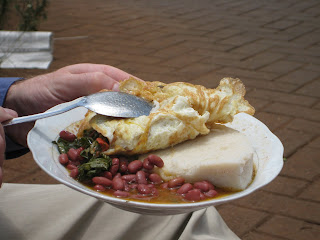 Typical 40 Cent Nairobi Lunch. Ugali Under the Fried Egg
My Ugandan colleagues demonstrated their hospitality in preparing a large plate of food for me on my last day. It was smoked fish in groundnut sauce (similar to peanuts) - a typical Ugandan dish. My new friends showed their generosity by heaping the plate with ugali and matoke, as well as a large portion of fish. The fish was tasty, but was not filleted, leaving me with a mouthful of bones. The sauce wasn’t bad (although it was purple and didn’t taste anything like nuts), but the combo was a little odd. I just couldn’t eat the ugali and matoke and felt like a little kid trying to hide it under a pile of fish bones and skin so as not to insult my hosts.
The trip went quickly and I arrived back in Nairobi Thursday night. This time, I was delighted to see Alex the Driver at the airport. Arriving in Nairobi had a very different feel than it had a mere two months ago - it felt familiar and like home, although I wasn’t looking forward to my bed - the one at the Sheraton was pretty darn close to perfection.
Sunday, October 26, 2008
Uganda Adventure
Nile River in Jinja, Uganda at Sunset
 I’m in Kampala, Uganda right now. I had planned on just coming for the weekend to meet Nancy and Naomi, two other Fellows and go rafting, but when I mentioned my weekend plans to my boss, she suggested I stay a few more days and work out of the PSI office here to get a feel for what a local office is like, as well as help the team complete some of their outstanding deliverables.
The weekend was great. Kampala is a much more social city than Nairobi because it is much safer. We were able to walk to a pub Friday night met a lot of other ex-pats. Saturday we got up very early to catch the rafting company’s van to Jinja, where we were going white water rafting. Nancy had organized some friends to join us, and it was a really fun group. It took about 1.5 hours to get to the base camp where we had breakfast and got fitted with our safety gear. Then, it was a short ride to the part of the Nile where we were putting in. We had the perfect number of people for our raft, so it was just us and our guide, Erik. Erik is a native Jinjan who looks like he is about twelve, but insisted he was 22. He gave us the basics on rafting as we had a mixed group in terms of experience. He then explained that there are 12 rapids through which we will be passing during the day, including a few Class 2 and 3, mostly some 4 and 5s and even a Class 6. The most difficult rapids are 6’s. The names of the rapids were very descriptive - Dead Dutchman, 50/50 (50% chance of getting out alive) and Widow Maker, to name a few.
The first part of the ride was fairly easy with some Class 2 and 3 water - nothing too hard. We got our rhythm and were working well as a team. However, we lost that confidence when we hit Silverback, a Class 5 rapid that defeated us and we went over. I’m a strong swimmer and confident in the water, but this knocked me for a loop. I got sucked down and turned around so many times, it was hard to figure out which way is up. I finally surfaced, I saw Nancy next to me and a safety boat and a rope in front of me. The kayakers and safety boats that accompanied us were great - they were at everyone’s side within seconds to haul them out of the water, and then embarrass them mercilessly for not managing to stay in the boat. What we later learned is that the guides are quite expert at what they do and often purposely find the spots in the rapids that will make the boat tip over, in order to give the patrons a more memorable experience.
Needless to say, it was a memorable experience and once we plucked all our passengers from the other boats that had picked them up, we were back on our way down river. We had some calm areas for a while and stopped about mid-way through the day for a floating lunch of pineapple and biscuits delivered to each boat. It was a chance to relax, go for a swim and gear up for the last part of the trip where we were to battle a Class 6 appropriately named The Bad Place. After going over a 5-meter waterfall and through a few other rapids, we were nearing the end of our trip. To get to the last rapid, we had to portage a bit, as the water between where we were and where we wanted to be was too difficult to navigate. As we climbed to the top of a cliff, we saw where the boats were to put in again and Mitra, one of Nancy’s friends and I decided that we had had enough. This was the end of the trip, the trucks with our dry clothes were right there, and we saw no reason to take such a risk at the end of the day. As neither of us plan to be professional rafters, it was no dishonor to skip this one.
We stood at the top of the cliff and watched as the rafts navigated the roiling water and, as one-by-one they tipped over, we congratulated ourselves on being so smart to be standing on the sidelines. The rest of our party made a go at the final rapid, but the guide purposely grounded them before they went into the most difficult part. We think that he decided that it was too much for only 2 semi-experienced passengers and 3 novices, so they hauled in. Still, it was a terrific experience.
After a barbeque, we stayed at the rafting campsite Saturday night, just hanging out and talking to the other trekkers. We were exhausted, but managed to stay awake until we got to watch the videotape of our day. I’m sure that every boatful of rafters thinks that their guide was the best and they had a better time than the other boats, but were quite sure it was true in our case, and I bought the video to prove it! I'll eventually put it up on the website, but here are a few pictures. We weren't able to take cameras along the river as they would be lost/ruined, but here are some from the porch of the campsite.
 Nile River in Jinja, Uganda at Dawn
 I’m in Kampala, Uganda right now. I had planned on just coming for the weekend to meet Nancy and Naomi, two other Fellows and go rafting, but when I mentioned my weekend plans to my boss, she suggested I stay a few more days and work out of the PSI office here to get a feel for what a local office is like, as well as help the team complete some of their outstanding deliverables.
The weekend was great. Kampala is a much more social city than Nairobi because it is much safer. We were able to walk to a pub Friday night met a lot of other ex-pats. Saturday we got up very early to catch the rafting company’s van to Jinja, where we were going white water rafting. Nancy had organized some friends to join us, and it was a really fun group. It took about 1.5 hours to get to the base camp where we had breakfast and got fitted with our safety gear. Then, it was a short ride to the part of the Nile where we were putting in. We had the perfect number of people for our raft, so it was just us and our guide, Erik. Erik is a native Jinjan who looks like he is about twelve, but insisted he was 22. He gave us the basics on rafting as we had a mixed group in terms of experience. He then explained that there are 12 rapids through which we will be passing during the day, including a few Class 2 and 3, mostly some 4 and 5s and even a Class 6. The most difficult rapids are 6’s. The names of the rapids were very descriptive - Dead Dutchman, 50/50 (50% chance of getting out alive) and Widow Maker, to name a few.
The first part of the ride was fairly easy with some Class 2 and 3 water - nothing too hard. We got our rhythm and were working well as a team. However, we lost that confidence when we hit Silverback, a Class 5 rapid that defeated us and we went over. I’m a strong swimmer and confident in the water, but this knocked me for a loop. I got sucked down and turned around so many times, it was hard to figure out which way is up. I finally surfaced, I saw Nancy next to me and a safety boat and a rope in front of me. The kayakers and safety boats that accompanied us were great - they were at everyone’s side within seconds to haul them out of the water, and then embarrass them mercilessly for not managing to stay in the boat. What we later learned is that the guides are quite expert at what they do and often purposely find the spots in the rapids that will make the boat tip over, in order to give the patrons a more memorable experience.
Needless to say, it was a memorable experience and once we plucked all our passengers from the other boats that had picked them up, we were back on our way down river. We had some calm areas for a while and stopped about mid-way through the day for a floating lunch of pineapple and biscuits delivered to each boat. It was a chance to relax, go for a swim and gear up for the last part of the trip where we were to battle a Class 6 appropriately named The Bad Place. After going over a 5-meter waterfall and through a few other rapids, we were nearing the end of our trip. To get to the last rapid, we had to portage a bit, as the water between where we were and where we wanted to be was too difficult to navigate. As we climbed to the top of a cliff, we saw where the boats were to put in again and Mitra, one of Nancy’s friends and I decided that we had had enough. This was the end of the trip, the trucks with our dry clothes were right there, and we saw no reason to take such a risk at the end of the day. As neither of us plan to be professional rafters, it was no dishonor to skip this one.
We stood at the top of the cliff and watched as the rafts navigated the roiling water and, as one-by-one they tipped over, we congratulated ourselves on being so smart to be standing on the sidelines. The rest of our party made a go at the final rapid, but the guide purposely grounded them before they went into the most difficult part. We think that he decided that it was too much for only 2 semi-experienced passengers and 3 novices, so they hauled in. Still, it was a terrific experience.
After a barbeque, we stayed at the rafting campsite Saturday night, just hanging out and talking to the other trekkers. We were exhausted, but managed to stay awake until we got to watch the videotape of our day. I’m sure that every boatful of rafters thinks that their guide was the best and they had a better time than the other boats, but were quite sure it was true in our case, and I bought the video to prove it! I'll eventually put it up on the website, but here are a few pictures. We weren't able to take cameras along the river as they would be lost/ruined, but here are some from the porch of the campsite.
Nile River in Jinja, Uganda at DawnMonday, October 20, 2008
Things I Love About Africa

- Jacaranda trees other vibrant plants and birds. Nothing is subtle here. Plants and animals are painted in bright colors not found in nature. But wait - it IS nature!
- Avocados and other tropical fruits are inexpensive and delicious. Too bad I don't like tropical fruits.
- A wonderful housekeeper who does my laundry and changes my sheets twice a week, and tries to get me to go to church with her.
- Katembas where you can buy lunch for 40 cents. I think the food is probably safe to eat, but the dishes and utensils are a bit suspect.
- NGO staffers are incredibly committed to their cause. They really do want to make a difference in the world and are not just here for the adventure.
- When it’s not raining, the weather is great - temperate, not humid and lots of sunshine.
- The people are very warm and friendly, and love to discuss US politics.
Friday, October 17, 2008
Things I Hate About Africa
- The metric system. I have no idea how much of anything I buy at the grocery store, let alone a unit price; how fast I go in a car; how far I go on the treadmill; how much a baby elephant weighs.
- Military time. What is with that? Not only does the power go off in the apartment fairly regularly so that I have to reset the clock on the microwave and add 12 to whatever time it REALLY is, but the TV Guide lists programs in military time, and they are either an hour ahead or an hour behind what is printed. I still haven’t figured out which it is.
- Driving on the wrong side of the road. I consistently look the wrong way when crossing a street and have very narrowly escaped getting hit by cars.
- Celsius. When the temperature is always somewhere between 20 and 23 degrees, it doesn’t seem like much of a difference, but the difference between 68 and 75 is significant.
- Speed bumps. They are everywhere here, making me think that a car is slowing down next to me for some nefarious reason, rather than to just calm traffic.
- Everything is SLOW. Nothing happens quickly here. Time does not equal money. There is no such thing as a quick run to the grocery store, as people are moving up and down the aisles with the speed of slugs. The only thing moving slower than the customers is the staff.
- Telephones. Countries have all different numbering conventions - some with 8 digits, some with 15. Calling cell-to-cell is different than cell-to-land line. Many of the African countries don’t have an infrastructure that even allows for any reliability and the Kenyan system is often overloaded. Good thing I don’t have anyone to call.
Tuesday, October 14, 2008
Into Africa - Part 2

Courting Giraffes
Sunday morning we were up early and ready to go. After being reprimanded by the hotel manager for taking coffee, bread and bananas to go (“That’s a full breakfast - you cannot return!”), we headed out in search of big cats. Unfortunately, we didn’t find any, but we had a lovely drive and came across some graceful giraffes performing a courtship dance. We didn’t stick around to see the results, but apparently many of the giraffes in the park are pregnant, so the dance is successful. We also spotted a jackal, and many other animals having breakfast.
 Jackal
Upon returning to the lodge for a rest (snoozing by the pool), we picked up our box lunches and left the park and headed for Lake Naivasha. The Rift Valley is an example of diverging tectonic plates, where molten lava pushed through the earth’s crust separating into two plates. A lake formed in the middle and you can see the dormant volcano above the lake, as well as others throughout the valley. We were told we could take a boat ride to an island, walk among the animals and then we would head back to Nairobi. Once again, it all sounded a bit nebulous, but Michael knew what he was doing.
We arrived at the camp, ate lunch and then hopped into a skiff with Captain John. He immediately took us to see a family of sleeping hippos, and pointed out many different species of birds along the shore. A little further down the coastline, there was a large group of people picnicking. The lake area is known for its greenhouses, and these were the employees enjoying a day off with their families, friends, donkeys and camels. Some of the men were net fishing and we pulled alongside and, again after much negotiation, bought some fish to be later thrown to the Fisher Eagles.
 Sleeping Hippos / Local Fisherman
The next stop was Crescent Island. No longer an actual island, this piece of land was where the movie Out of Africa was filmed in 1985. Prior to that, there was very little wildlife there, but thanks to Hollywood and a Noah’s ark-like maneuver, the island now has large herds of wildebeest, antelope, gazelle, dik dik, zebra and giraffes. Our guide Simon explained that we could walk around the island without fear of being trampled by animals as they were “very social”. We took him at his word and started off.
The island was beautiful with gently sloping hills, lush greenery and animals everywhere. Some of them had had a better year than others, as one of the first things we came across was a buffalo carcass. We were able to get very close to a giraffe, and learned that, according to Simon, wildebeest are the most stupid of all of God’s creatures as they follow the same migratory path year after year, knowing that it brings them directly into the path of crocodiles, lions and cheetahs.


Wildebeest / Bad Day for Buffalo
After an hour or so of wandering among the animals, we got back in the boat to feed the Fisher Eagles. Captain John would spot them in the trees, whistle to catch their attention and then throw a fish in the water. Within seconds, the eagle would swoop down and pluck it out of the lake. It was very impressive.
Although we had exerted very little actual effort throughout the day, we were happy to return to the van and head back to Nairobi. We took the same route back, but a short way outside of Naivasha, Michael suddenly pulled the van over to the side of the road were there were dozens of people milling around. A boy jumped into the front seat and Michael explained that it was his son who was heading to the city. It seemed a bit random to us, but we were too tired to try to understand it better.
 Fisher Eagle with Fish (really)
Subscribe to:
Posts (Atom)

 Posts
Posts

